Ammunitions
Introduction
Ammunition (informally ammo) is the material fired, scattered, dropped or detonated from any weapon or weapon system. Ammunition is both expendable weapons (e.g., bombs, missiles, grenades, land mines) and the component parts of other weapons that create the effect on a target (e.g., bullets and warheads). Nearly all mechanical weapons require some form of ammunition to operate.
The term ammunition can be traced back to the mid-17th century. The word comes from the French la munition, for the material used for war. Ammunition and munitions are often used interchangeably, although munition now usually refers to the actual weapons system with the ammunition required to operate it. In some languages other than English ammunition is still referred to as munition, such as French (“munitions”), German (“Munition”), Italian (“munizione”) or Portuguese (“munição”).
The purpose of ammunition is to project a force against a selected target to have an effect (usually, but not always, lethal). The most iconic example of ammunition is the firearm cartridge, which includes all components required to deliver the weapon effect in a single package.
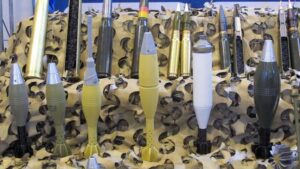
Ammunition comes in a great range of sizes and types and is often designed to work only in specific weapons systems. However, there are internationally recognized standards for certain ammunition types (e.g., 5.56×45mm NATO) that enable their use across different weapons and by different users. There are also specific types of ammunition that are designed to have a specialized effect on a target, such as armor-piercing shells and tracer ammunition, used only in certain circumstances. Ammunition is commonly labeled or colored in a specific manner to assist in the identification and to prevent the wrong ammunition types from being used accidentally or inappropriately.
Ammo Design
Ammunition design has evolved throughout history as different weapons have been developed and different effects required. Historically, ammunition was of relatively simple design and build (e.g., sling-shot, stones hurled by catapults), but as weapon designs developed (e.g., rifling) and became more refined, the requirement for more specialized ammunition increased. Modern ammunition can vary significantly in quality but is usually manufactured to very high standards.
For example, ammunition for hunting can be designed to expand inside the target, maximizing the damage inflicted by a single round. Anti-personnel shells are designed to fragment into many pieces and can affect a large area. Armor-piercing rounds are specially hardened to penetrate armor, while smoke ammunition covers an area with a fog that screens people from view. More generic ammunition (e.g., 5.56×45mm NATO) can often be altered slightly to give it a more specific effect (e.g., tracer, incendiary), whilst larger explosive rounds can be altered by using different fuzes.
Components
The components of ammunition intended for rifles and munitions may be divided into these categories:
- Fuze or primer
- explosive materials and propellants
- projectiles of all kinds
- cartridge casing
Fuzes
The term “fuze” refers to the detonator of an explosive round or shell. The spelling is different in British English and American English (fuse/fuze respectively) and they are unrelated from a fuse (electrical). A fuse was earlier used to ignite the propellant (e.g., such as on a firework) until the advent of more reliable systems such as the primer or igniter that is used in most modern ammunitions.
The fuze of a weapon can be used to alter how the ammunition works. For example, a common artillery shell fuze can be set to ‘point detonation’ (detonation when it hits the target), delay (detonate after it has hit and penetrated the target), time-delay (explode a specified time after firing or impact) and proximity (explode above or next to a target without hitting it, such as for airburst effects or anti-aircraft shells). These allow a single ammunition type to be altered to suit the situation it is required for. There are many designs of a fuze, ranging from simple mechanical to complex radar and barometric systems.
Fuzes are usually armed by the acceleration force of firing the projectile, and usually arm several meters after clearing the bore of the weapon. This helps to ensure the ammunition is safer to handle when loading into the weapon and reduces the chance of the detonator firing before the ammunition has cleared the weapon.
Propellant or Explosive
The propellant is the component of ammunition that is activated inside the weapon and provides the kinetic energy required to move the projectile from the weapon to the target. Before the use of gunpowder, this energy would have been produced mechanically by the weapons system (e.g., a catapult or crossbow); in modern times, it is usually a form of chemical energy that rapidly burns to create kinetic force, and an appropriate amount of chemical propellant is packaged with each round of ammunition. In recent years, compressed gas, magnetic energy and electrical energy have been used as propellants.
Until the 20th-century, gunpowder was the most common propellant in ammunition. However, it has since been replaced by a wide range of fast-burning compounds that are more reliable and efficient.
The propellant charge is distinct from the projectile charge which is activated by the fuze, which causes the ammunition effect (e.g., the exploding of an artillery round).
Cartridges Case or Container
The cartridge is the container that holds the projectile and propellant. Not all ammunition types have a cartridge case. In its place, a wide range of materials can be used to contain the explosives and parts. With some large weapons, the ammunition components are stored separately until loaded into the weapon system for firing. With small arms, caseless ammunition can reduce the weight and cost of ammunition, and simplify the firing process for increased firing rate, but the maturing technology has functionality issues.
Projectile
The projectile is the part of the ammunition that leaves the weapon and has the effect on the target. This effect is usually either kinetic (e.g., as with a standard bullet) or through the delivery of explosives.